Published 24 August 2026
Why must wheel bolts be tightened with a torque wrench?
An impact wrench is fast, but it does not confirm the final clamping torque. Here is why a torque wrench matters and why wheels are checked again after about 50 km.
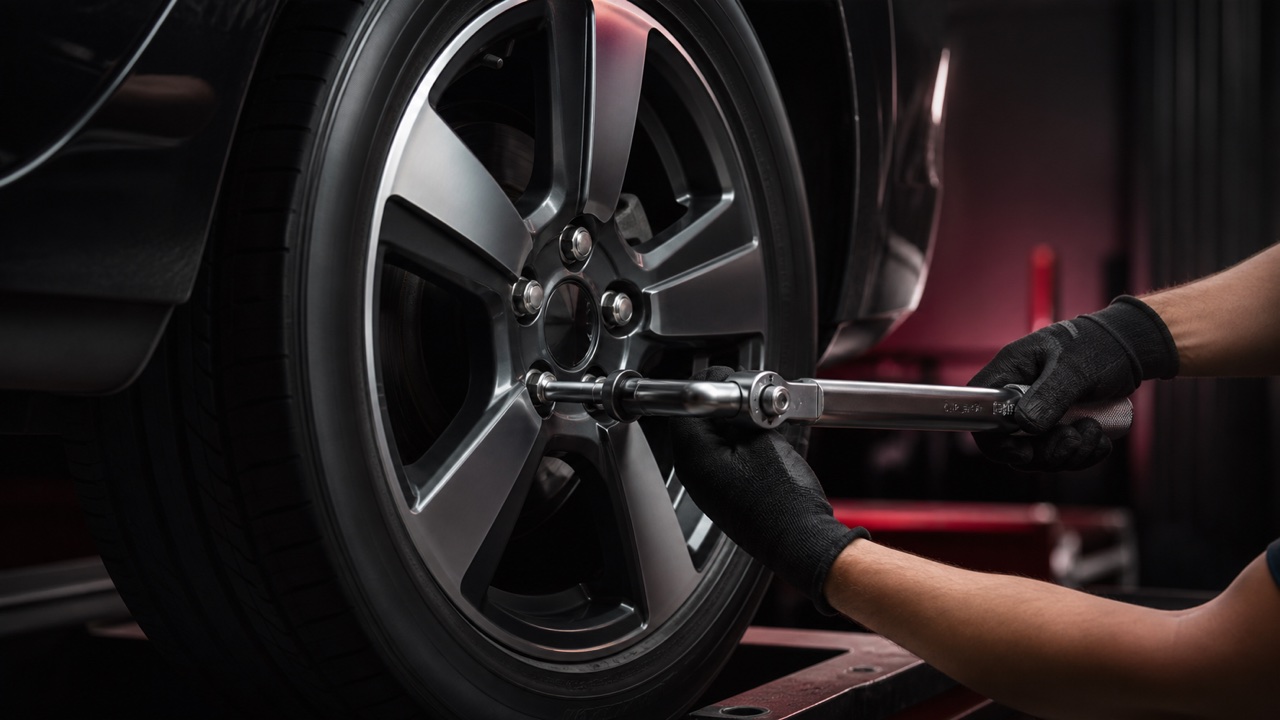
An impact wrench is not a bad workshop tool. It removes fasteners quickly and can help snug bolts during installation. The problem starts when the impact gun is also used as the final check. Its output changes with battery charge, air pressure, socket, tool design and even how long the trigger is held. It does not confirm an exact final torque.
What is tightening torque?
It is the vehicle manufacturer's specified turning force, normally measured in newton-metres (Nm), that allows a bolt or nut to clamp the wheel to the hub. The value differs between vehicles; “120 Nm for everything” is not a professional method. The correct number comes from the documentation for that specific vehicle.
What happens when bolts are over-tightened?
- A bolt or stud can stretch and the threads can be damaged.
- The wheel may be impossible to remove roadside with the vehicle's standard wrench.
- Uneven excessive force can place the wrong load on the wheel, hub and brake components.
Under-tightening is not a gentler option. The joint can move, vibration appears, mounting surfaces are damaged and, in the worst case, the wheel can separate from the vehicle.
What is the correct procedure?
- Clean the wheel and hub contact surfaces; start the bolts by hand to protect the threads.
- Snug the fasteners evenly in a cross or star sequence.
- Apply the final value with a calibrated torque wrench set to the specification for the vehicle.
Do not lubricate the threads unless the vehicle manufacturer explicitly requires it. Lubrication changes friction, which can overload the bolt even though the torque wrench displays the familiar number.
Why check again after about 50 km?
During the first journeys, the contact surfaces settle and experience load plus heating and cooling cycles. A brief follow-up check on cool wheels is therefore recommended after a wheel change. This does not mean “tighten harder”: the torque wrench simply confirms that every fastener still holds the value specified by the manufacturer.
Blog
Published 22 October 2026
What does a tire change price include, and why does it vary?
A price per wheel, a four-wheel set and tire remounting are different offers. Here is what to check before comparing workshop prices.
Read more
Published 22 October 2026
Complete wheel changes or tire fitting: what is the difference?
Two seasonal sets with their own rims and two tire sets sharing one set of rims involve different jobs. Here is the plain explanation.
Read more
Published 22 October 2026
How to organise fleet tire changes in your company car park
To avoid vehicles waiting without a reason, start with a list and a sequence. A practical preparation guide for businesses.
Read more